

Enterprise organizations rarely struggle because they lack data. The real challenge is that customer information exists everywhere.
Sales teams work inside pipelines and opportunity dashboards; support teams manage cases separately, while marketing departments run campaigns through different platforms. Customer interactions become fragmented, and leadership loses visibility into the complete journey. This is why Salesforce cross-cloud integration is becoming a priority for enterprises managing complex customer ecosystems.
Many organizations invest in CRM platforms but still operate in silos. Sales knows pipeline activity, support understands service history, and marketing tracks engagement campaigns, yet none of these teams see the full customer picture. As companies expand across regions, products, and departments, disconnected systems create reporting gaps, duplicate processes, inconsistent customer experiences, and slower decision-making.
Businesses adopting enterprise CRM consulting in India and cross-functional transformation strategies are increasingly connecting Sales Cloud, Service Cloud, and Marketing Cloud into one operational environment.

Why Disconnected Departments Create Customer Visibility Problems
Most enterprises do not fail because teams avoid technology. They struggle because systems grow independently over time. Sales implementations happen first, service environments are added later, and marketing automation enters separately. Eventually organizations operate multiple tools without unified customer visibility.
This creates operational friction across departments. Sales representatives may not know active support issues before customer meetings. Marketing teams continue campaigns without understanding customer complaints. Service agents lack visibility into open opportunities and buying intent.
Common business impacts include:
Duplicate customer records
Fragmented reporting environments
Inconsistent engagement journeys
Delayed decision-making
Poor visibility across teams
Organizations implementing Salesforce cross-cloud integration aim to remove these visibility gaps and create connected customer operations.
Connecting Sales Cloud, Service Cloud and Marketing Cloud Into One Customer View
A unified customer environment helps organizations move away from departmental reporting and toward shared intelligence. Instead of each team working independently, information becomes accessible across the customer lifecycle.
Sales teams gain visibility into support history. Service teams understand purchase activity. Marketing departments access engagement behavior and campaign interactions.
Enterprises investing in cross-cloud integration commonly improve:
What Connected Teams Gain
- Customer lifecycle visibility
- Cross-functional collaboration
- Reporting accuracy
- Campaign personalization
- Support responsiveness
This connected approach becomes especially important for businesses operating across multiple countries and business units.
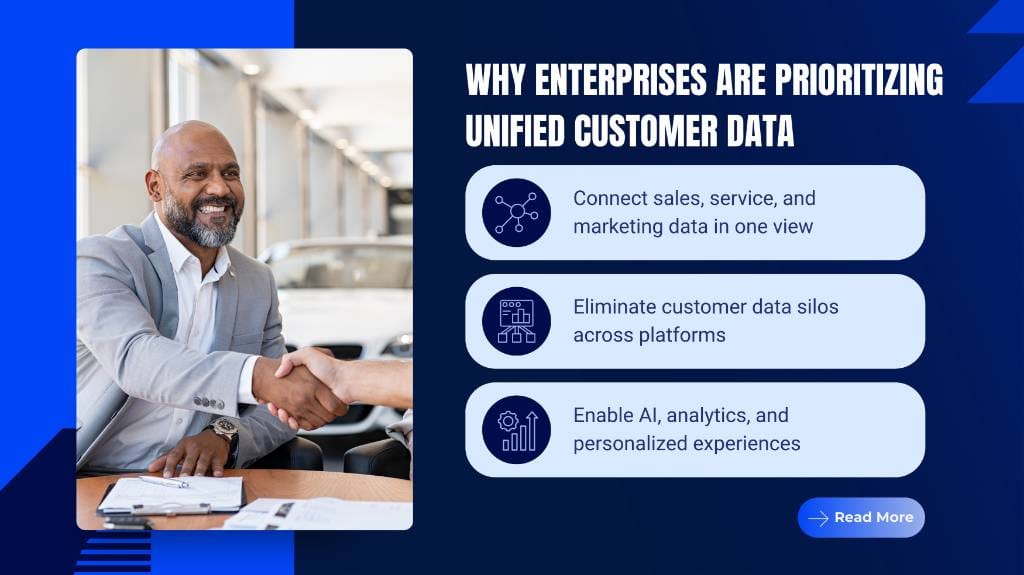
Why Enterprises Are Prioritizing Unified Customer Data
Modern customers interact across websites, support channels, email campaigns, mobile applications, field teams, e-commerce platforms, and sales representatives. Without integration, organizations build isolated customer histories instead of unified profiles.
Businesses increasingly use cross-cloud strategies to support customer experience initiatives, AI programs, analytics environments, and operational reporting.
Teams generally connect:
Organizations adopting enterprise CRM consulting in India often discover integration creates more value than adding additional tools.
Salesforce Cross-Cloud Integration and AI Readiness
AI initiatives depend heavily on connected information. If customer records remain fragmented, AI outputs become incomplete and decision quality declines.
Companies preparing AI-enabled CRM environments increasingly prioritize integration before introducing analytics and automation initiatives.
Cross-cloud environments help support:
Customer intelligence programs
AI-driven recommendations
Journey orchestration
Unified reporting systems
Predictive engagement models
This creates stronger foundations for future customer experience programs.
Implementation Challenges Enterprises Should Address Early
Cross-cloud projects become difficult when integration planning begins too late. Many organizations configure clouds separately and attempt integration afterward.
Successful implementations usually review architecture, reporting models, workflows, permissions, data ownership, and operational dependencies early.
High-performing enterprise programs normally focus on alignment across:
Late Integration
- Clouds configured in isolation
- Architecture decided ad hoc
- Governance addressed afterward
- Higher rework during expansion
Early Alignment
- Business processes mapped first
- Customer journeys defined upfront
- Data governance built in
- Department collaboration planned
This reduces complexity during expansion.
"Connected systems no longer represent a technology advantage alone. They increasingly become a business requirement."

Why Cross-Cloud Integration Is Becoming a Competitive Requirement
Customer experience expectations continue increasing across industries. Organizations can no longer rely on isolated departmental systems because customers expect continuity regardless of interaction channel.
Enterprises implementing Salesforce cross-cloud integration create stronger customer visibility, better collaboration, improved reporting accuracy, and scalable digital ecosystems.
Conclusion
Salesforce cross-cloud integration helps enterprises eliminate disconnected customer experiences by connecting sales, service, and marketing environments. Organizations investing in enterprise CRM consulting India increasingly prioritize unified customer views because visibility directly affects customer experience, analytics, operational efficiency, and future AI readiness.
Frequently Asked Questions
What is Salesforce cross-cloud integration?
It connects Salesforce environments such as Sales Cloud, Service Cloud, and Marketing Cloud into a unified customer ecosystem.
Why do enterprises implement cross-cloud environments?
To improve visibility, reduce silos, strengthen reporting, and create better customer experiences.
Does integration support AI initiatives?
Yes. Unified customer data improves AI accuracy, analytics quality, and personalization programs.
Which industries benefit from cross-cloud integration?
Manufacturing, financial services, retail, healthcare, BPOs, technology companies, and enterprises managing multiple departments.
Ready to Connect Your Customer Ecosystem?
Valuehub helps enterprises unify Sales Cloud, Service Cloud, and Marketing Cloud into one customer view.