

"Organizations must align CRM strategy with governance requirements before configuration, integration, and migration activities start."
Financial institutions in Malaysia are accelerating digital transformation programs to improve customer onboarding, relationship management, service delivery, and operational visibility. Banks and insurance providers are investing in CRM modernization because legacy systems struggle to support growing customer expectations, regulatory demands, and cross-channel experiences.
Many banking and insurance firms still manage customer interactions through fragmented environments where onboarding systems, policy records, service applications, relationship management tools, and reporting platforms operate separately. This creates visibility issues and increases operational risk.
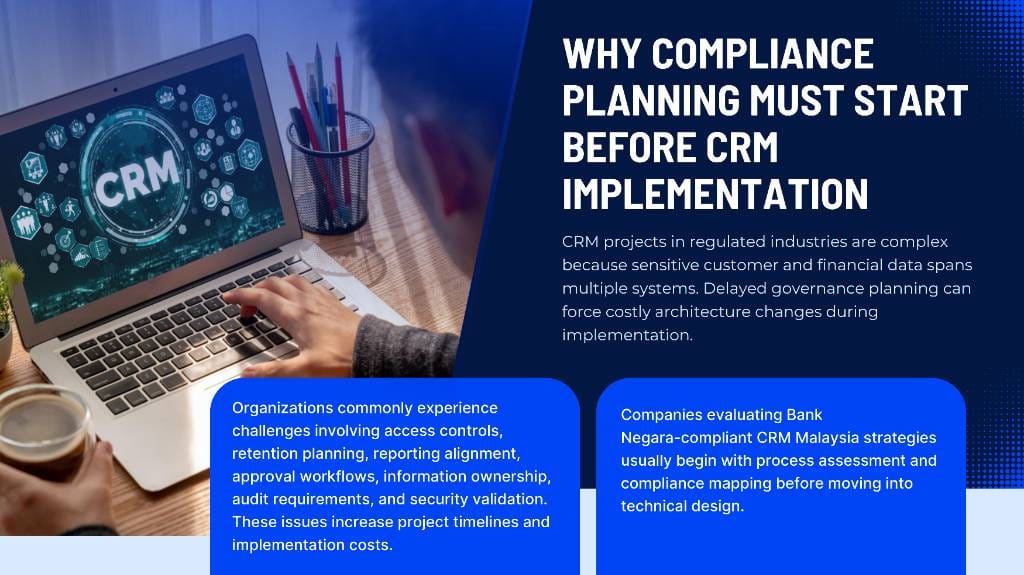
Why Compliance Planning Must Start Before CRM Implementation
CRM projects in regulated industries are more complex than standard deployments because customer records, transaction information, policy history, claims activity, service interactions, and financial data move across multiple systems. When governance planning is delayed, implementation teams often redesign architecture midway through projects.
🔐 Access Controls
Role-based permissions must be defined before deployment, not after.
🗂️ Retention Planning
Data lifecycle rules need to be set ahead of migration activities.
📊 Reporting Alignment
Regulatory reporting structures must map cleanly to CRM data models.
✅ Approval Workflows
Governance sign-off processes need to be built into the project plan.
How Salesforce Supports Financial Services Transformation
Banks and insurers adopting Salesforce implementation in Malaysia increasingly use centralized environments to improve customer visibility, relationship tracking, service operations, and workflow management. Instead of maintaining separate operational systems, organizations move toward connected customer platforms.
Unified Customer Onboarding
Faster, consistent onboarding experiences across banking and insurance products.
Centralized Case Handling
Service teams resolve cases faster with full customer context in one place.
Advisor Productivity
Relationship managers access complete customer history without switching systems.
Policy Servicing
Claims and policy data connected to the same customer record for faster service.
Customer Communication Management
Consistent messaging across every touchpoint and department.
Regulatory Risk Areas Financial Teams Should Address Early
Compliance gaps usually appear when projects prioritize features before governance. Successful organizations generally review data architecture, integration paths, permissions, reporting flows, document controls, and operational dependencies before deployment.
"Early reviews reduce rework during implementation and help avoid later redesign efforts."
Why Banks and Insurance Companies Are Modernizing CRM
Malaysian financial institutions are under pressure to improve customer experiences while maintaining regulatory alignment. Customers now expect faster onboarding, personalized interactions, digital servicing, and consistent experiences across channels. Legacy systems often create barriers because information remains distributed across departments.
Relationship Visibility
One connected view of every customer across products and departments.
Operational Efficiency
Reduced manual effort and faster case resolution across teams.
Reporting Consistency
Unified data model supports accurate, repeatable regulatory reporting.
Stronger Governance
Built-in controls reduce compliance risk across the customer lifecycle.
Building Compliance Into CRM Projects
Implementation success depends less on software selection and more on planning maturity. High-performing projects typically establish governance models before deployment begins, including compliance teams, operations leaders, and security specialists early in planning cycles.
Areas of Impact for Regulated Financial Teams
Banks managing complex onboarding and lending workflows
Insurance providers handling policy and claims data
Lending institutions requiring audit-ready reporting
Financial advisory firms managing client relationships
Frequently Asked Questions
What is Bank Negara compliant CRM Malaysia?
It refers to CRM environments designed with governance, operational controls, compliance planning, and reporting alignment for Malaysian financial institutions.
Why do banks use Salesforce?
Banks use Salesforce to improve relationship management, customer visibility, service workflows, onboarding experiences, and operational reporting.
Is compliance planning required before CRM implementation?
Yes. Governance reviews performed early help reduce implementation delays and lower operational risk.
Which organizations benefit most?
Banks, insurance providers, lending institutions, financial advisory firms, and regulated service providers commonly benefit.
Planning a Compliant CRM Implementation in Malaysia?
Valuehub helps banks and insurers align governance, compliance, and Salesforce implementation from day one.