

Enterprise companies often have plenty of customer data but still struggle to turn that data into timely, personalized engagement.
Salesforce can provide valuable customer, account, sales and service information, while Braze specializes in real-time customer engagement across channels. When these platforms are connected properly, businesses can use CRM intelligence to inform engagement while sending behavioral and campaign signals back into their broader customer ecosystem.
That makes Braze Salesforce integration more than a simple data connection. It can become an important part of an enterprise customer engagement architecture.
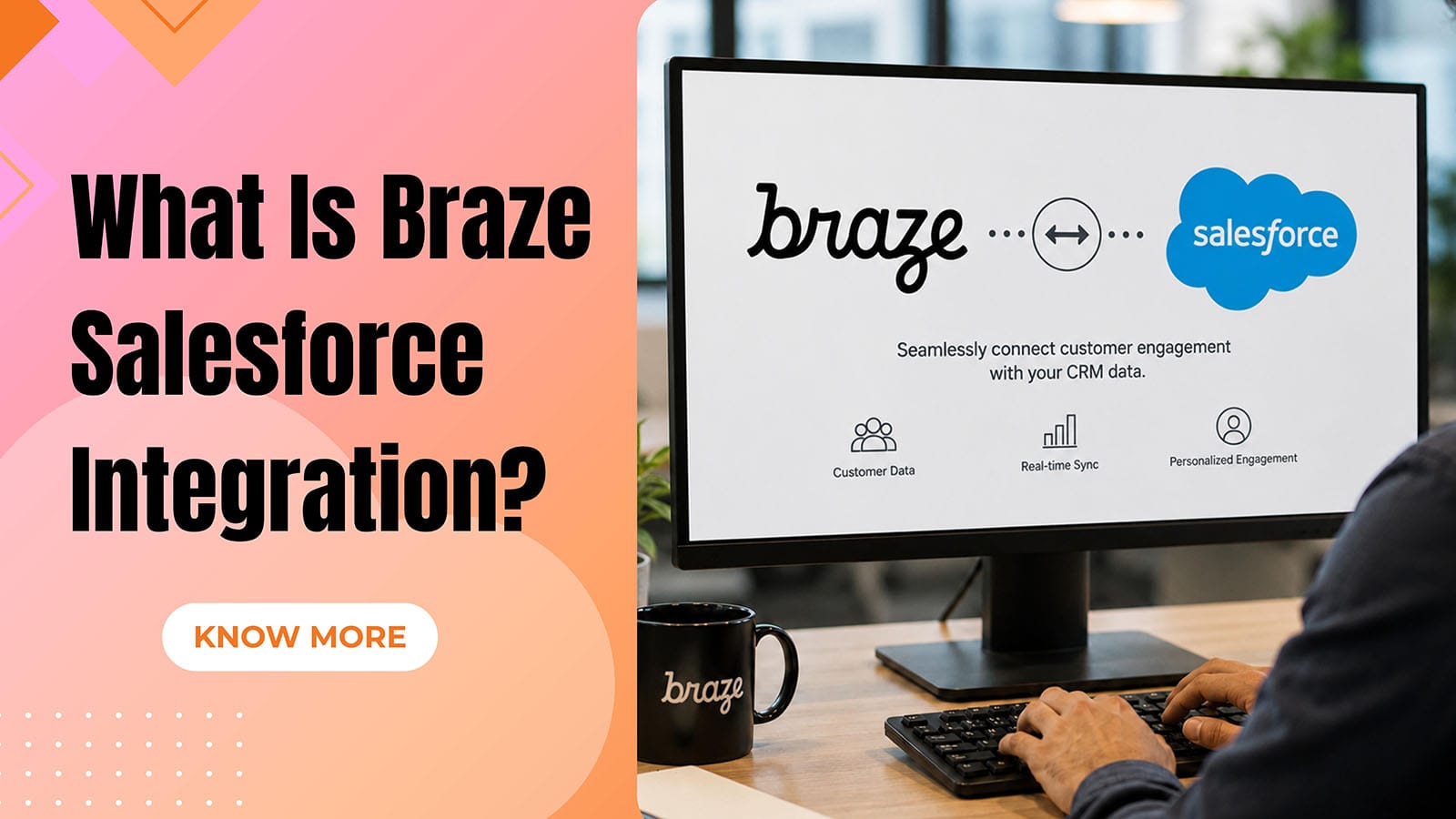
What Is Braze Salesforce Integration?
Braze Salesforce integration connects customer and business data between Salesforce and Braze so teams can use CRM information alongside behavioral and engagement data.
Salesforce can act as the source of important customer and account information, while Braze can use that information to create segments, personalize campaigns and orchestrate customer journeys.
Braze's current platform focuses on data unification, real-time activation, cross-channel engagement and AI-powered decisioning.
A typical architecture can look like:
The exact architecture depends on the organization's Salesforce setup, data model, privacy requirements and engagement use cases.
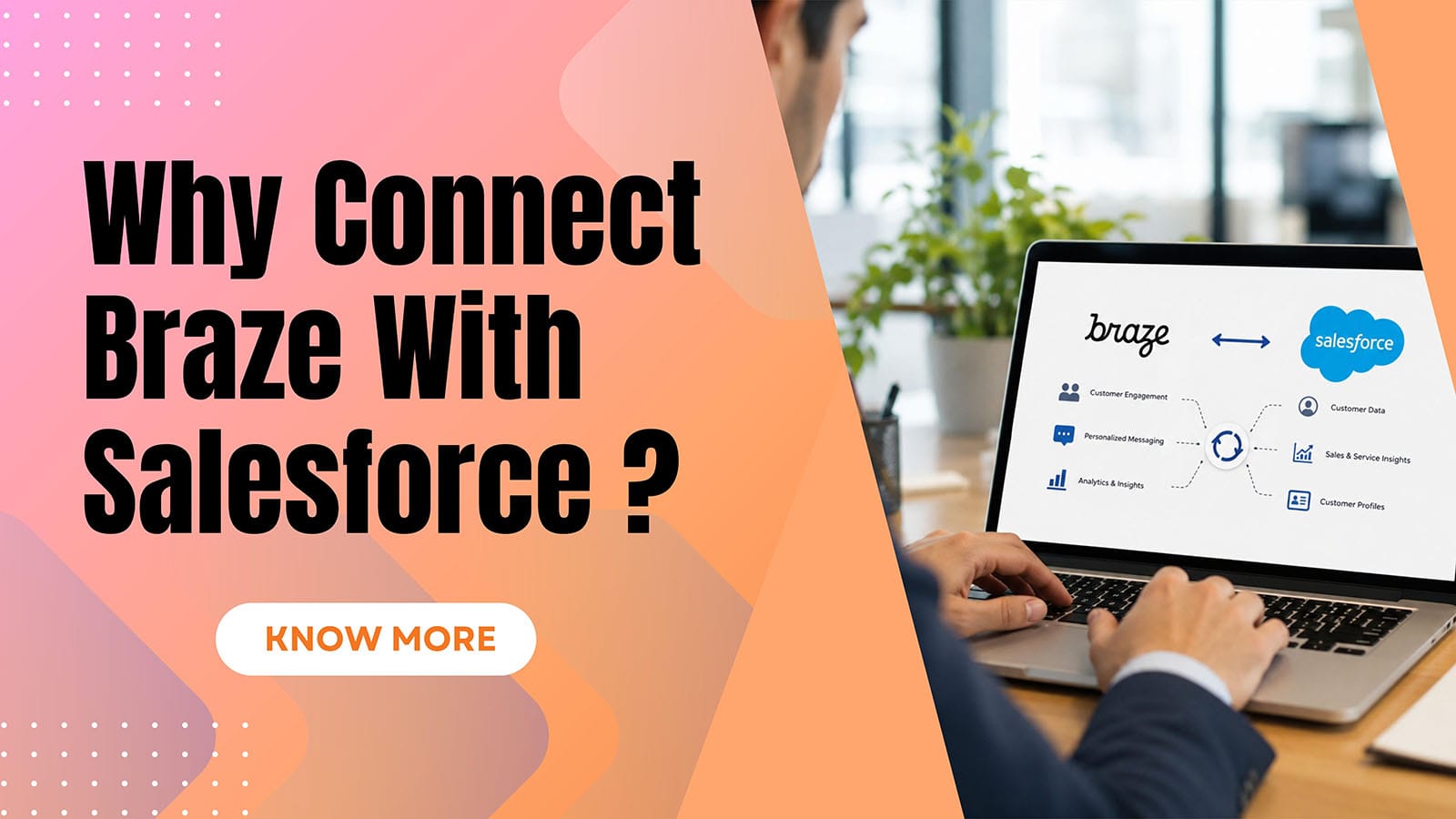
Why Connect Braze With Salesforce?
Salesforce and Braze solve different parts of the customer engagement problem.
Salesforce
- CRM relationships and accounts
- Leads and opportunities
- Cases and customer interactions
- Sales and service data
Braze
- Real-time customer engagement
- Cross-channel messaging
- Behavioral segmentation
- Journey orchestration
Connecting the two can help organizations bring these capabilities together.
1. Connect CRM Context With Customer Behavior
A customer's Salesforce profile can provide business context that behavioral data alone may not capture. For example, a business could combine:
This creates a richer foundation for segmentation and personalization.
2. Build More Personalized Customer Journeys
Braze can use customer data and behavioral events to support real-time engagement across channels. For example:
Braze supports engagement data collection across product behavior, messaging, surveys, CRM and third-party integrations.
3. Improve Cross-Channel Engagement
Enterprise customers rarely interact through one channel. Depending on the business model, engagement can include email, mobile push, in-app messaging, SMS, web experiences and other digital channels. Braze is specifically designed for cross-channel customer engagement and journey orchestration.
Salesforce data can provide additional context for deciding who should receive a message, when they should receive it and what the message should contain.
4. Close the Engagement-to-Revenue Loop
One of the biggest advantages of connecting engagement and CRM systems is visibility beyond campaign metrics. Instead of measuring only Open → Click → Conversion, enterprise teams can connect engagement activity with broader business outcomes such as:
This can help marketing and sales teams understand which customer engagement activities contribute to pipeline and revenue.
What Data Can Move Between Salesforce and Braze?
The exact data architecture depends on the implementation, but organizations may synchronize information such as:
| Salesforce Data | Braze Engagement Data |
|---|---|
| Customer attributes | Email engagement |
| Lead information | Push interactions |
| Account information | In-app engagement |
| Customer lifecycle stage | Campaign interactions |
| Purchase information | Behavioral events |
| Sales activity | Journey activity |
| Service information | Engagement responses |
Braze supports multiple approaches for ingesting and distributing customer data, including APIs, SDKs, cloud data ingestion and integrations.
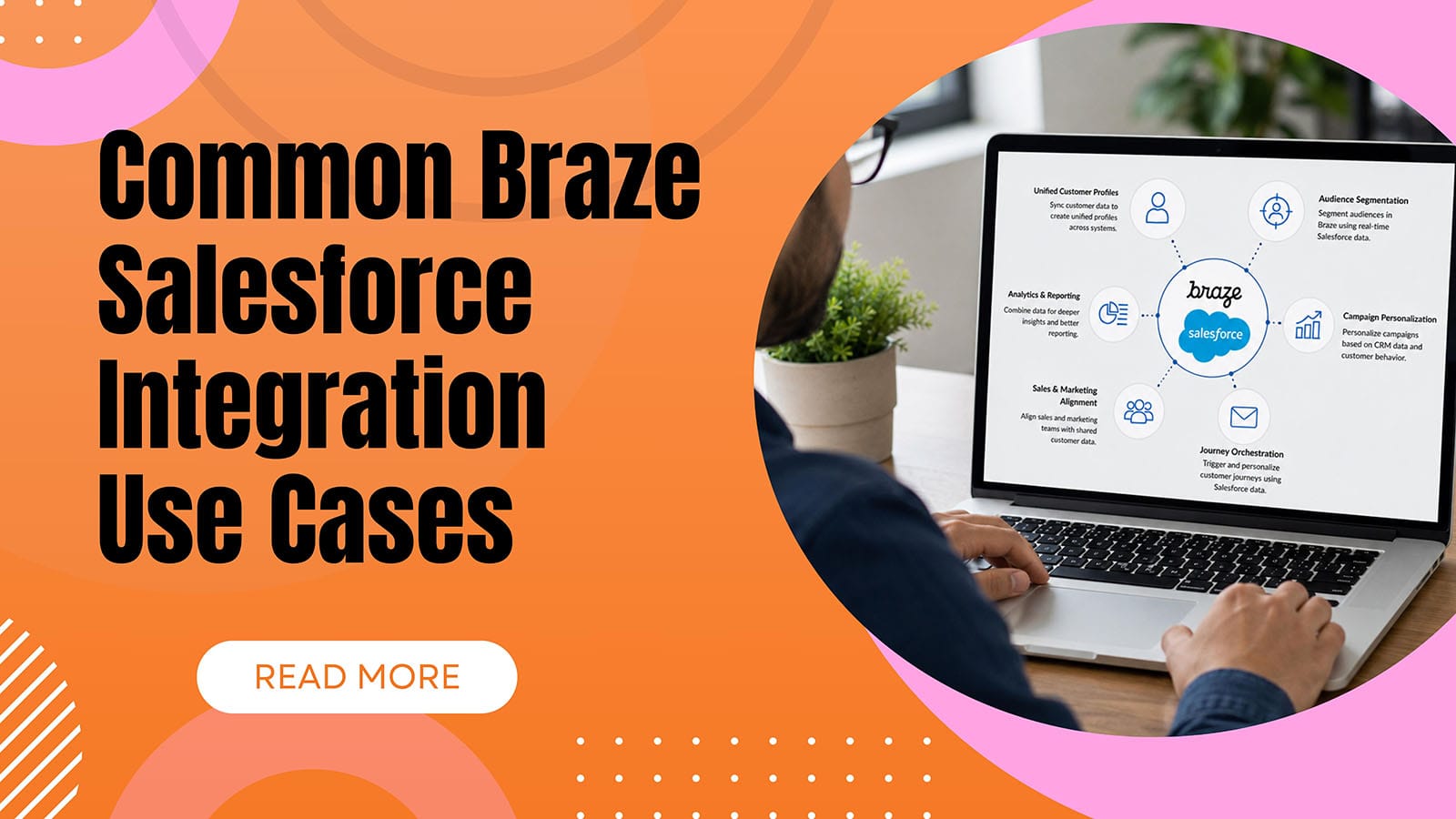
Common Braze Salesforce Integration Use Cases
The integration becomes particularly valuable when customer engagement depends on CRM context.
Lead Nurturing
Salesforce lead information can help identify customer segments, while Braze can deliver personalized engagement based on behavior.
Customer Onboarding
After a customer becomes active, Braze can orchestrate onboarding journeys based on customer attributes and product activity.
Customer Retention
Businesses can combine customer lifecycle information with behavioral signals to identify customers who may need additional engagement.
Cross-Sell and Upsell
Salesforce can provide account and customer context while Braze can activate personalized campaigns based on engagement and behavioral signals.
Re-Engagement
Inactive customers can be identified using behavioral signals and combined with CRM information to create targeted win-back journeys.
How to Approach a Braze Salesforce Integration
A successful implementation should begin with the customer data architecture, not the integration technology.
Define the Business Use Cases
Determine what the integration needs to achieve — lead nurturing, onboarding, retention, cross-selling, personalization or customer lifecycle management.
Map the Data
Identify which Salesforce objects and fields need to be available in Braze. Avoid transferring unnecessary data.
Establish Identity Resolution
Determine how customer identities will be matched between systems. This is critical when organizations have multiple identifiers across CRM, websites, mobile applications and other platforms.
Define Data Direction
Determine whether data needs to move Salesforce → Braze, Braze → Salesforce, or both directions.
Define Real-Time Requirements
Not every data point needs real-time synchronization. Determine which events require immediate activation and which can be processed periodically.
Implement Governance
- Data privacy and access controls
- Data quality and consent management
- Field ownership and error handling
- Monitoring and security
Measure Business Outcomes
- Engagement rate and conversion rate
- Retention and customer lifetime value
- Revenue influenced by campaigns
- Journey completion and customer experience metrics
Braze vs Salesforce: Why Enterprises May Use Both
The question isn't necessarily Braze vs Salesforce. For some enterprises, the stronger architecture can be Braze + Salesforce.
Salesforce's strength is its broader CRM ecosystem and relationship data, while Braze focuses heavily on real-time customer engagement and cross-channel orchestration. Braze itself describes this complementary model, where Salesforce can remain the CRM system of record while Braze handles real-time engagement.
This distinction is important when evaluating customer engagement technology.
Common Integration Challenges
A technically connected system does not automatically create a successful customer engagement program. Common challenges include:
Poor Data Quality
Incorrect or incomplete CRM data can create inaccurate segments and personalization.
Duplicate Customer Records
Different identifiers between systems can lead to fragmented customer profiles.
Over-Synchronization
Sending every available CRM field to the engagement platform can create unnecessary complexity.
Lack of Data Governance
Teams need clear ownership of customer data and synchronization rules.
Weak Journey Design
Technology cannot compensate for poorly designed customer journeys.
Limited Measurement
Tracking campaign opens and clicks without connecting engagement to business outcomes limits the value of the integration.
The Future of Braze + Salesforce for Enterprise Engagement
Customer engagement is moving from campaign-based marketing toward real-time, context-aware experiences. That requires businesses to connect three important capabilities:
Salesforce can provide critical CRM context, while Braze can activate customer engagement based on behavior and real-time signals. Braze's recent product direction also emphasizes real-time data activation and AI-powered engagement, reinforcing the importance of connected customer-data architectures for enterprise teams.
"Done correctly, the combination can create a more connected customer engagement engine across marketing, sales and customer experience."
Frequently Asked Questions
Can Braze integrate with Salesforce?
Yes. Braze and Salesforce can be connected so organizations can use CRM and customer engagement data across their technology stack. The implementation approach depends on the organization's architecture and use cases.
What is the benefit of Braze Salesforce integration?
The primary benefit is connecting Salesforce customer and business context with Braze's real-time engagement capabilities to support more relevant and personalized customer journeys.
Is Braze better than Salesforce Marketing Cloud?
Neither platform is universally better. They have different strengths and should be evaluated based on the organization's CRM, engagement, data and orchestration requirements.
Can Salesforce remain the system of record?
Yes. An enterprise can retain Salesforce as its CRM system of record while using Braze as the customer engagement layer.
What data can be synchronized between Salesforce and Braze?
Depending on the architecture, organizations can synchronize customer attributes, lifecycle information, engagement events, campaign data and other relevant customer information.
Final Takeaway
Braze Salesforce integration is not simply about connecting two platforms. It is about connecting customer intelligence with real-time engagement.
Salesforce can provide the CRM context. Braze can activate that context through personalized, cross-channel experiences. When supported by strong data governance, identity resolution and measurement, the combination can become a powerful foundation for enterprise customer engagement.
Ready to Build a Unified Customer Engagement Engine?
Valuehub helps enterprise teams connect Salesforce and Braze for real-time, personalized customer engagement.