

Scaling Customer Support: How Salesforce Service Cloud Transforms Enterprise Operations
In today's competitive digital economy, customer service is no longer a reactive cost center. It has become a main driver of growth, retention, and long term brand loyalty. Yet many growing organizations still struggle with disjointed support channels, communication silos, and legacy systems that slow down response times.
When inquiries are scattered across inboxes, legacy ticketing tools, and separate phone logs, customer satisfaction drops and agent burnout rises. Forward thinking enterprises are moving to a unified CRM to fix this. Valuehub delivers Salesforce Service Cloud implementation to unify customer operations across India, Singapore, the Philippines, Indonesia, and Malaysia.
1. The Hidden Costs of Fragmented Customer Service Systems
Many enterprises build fragmented technology stacks out of necessity. As the company scales, each department adopts its own tools. Sales uses one platform, billing uses another, and support agents juggle a legacy ticketing tool that talks to nothing else.
These patchwork setups can look fine on the surface, but they create real costs. To compare how enterprise platforms are built, you can also review the official Salesforce Service Cloud overview.
Four Costs of a Patchwork Support Stack
Each one quietly drains budget, time, and customer goodwill.
Siloed Customer Data
Purchase records, history, and past complaints live in separate databases. Agents switch between tabs to answer one question, and customers have to repeat their issue.
Inflated Resolution Times
Without one workspace, routing a ticket to the right tier means manual steps and internal email chains. Average Handle Time and First Response Time both climb.
Zero Leadership Visibility
When data is fractured, managers cannot track performance, spot recurring product bugs, or forecast staffing needs. Planning becomes guesswork.
High Operational Overhead
Multiple licenses, custom API bridges, and separate vendor contracts eat IT budget that could fund product innovation instead.
Fixing these problems means moving to one connected, intelligent service platform. That is exactly what Service Cloud is built to do.

2. Core Features That Drive First Contact Resolution
First Contact Resolution (FCR) is one of the most watched support metrics. When an issue is solved in the first interaction, satisfaction rises, costs fall, and agents feel more successful. Service Cloud includes native tools designed to raise FCR.
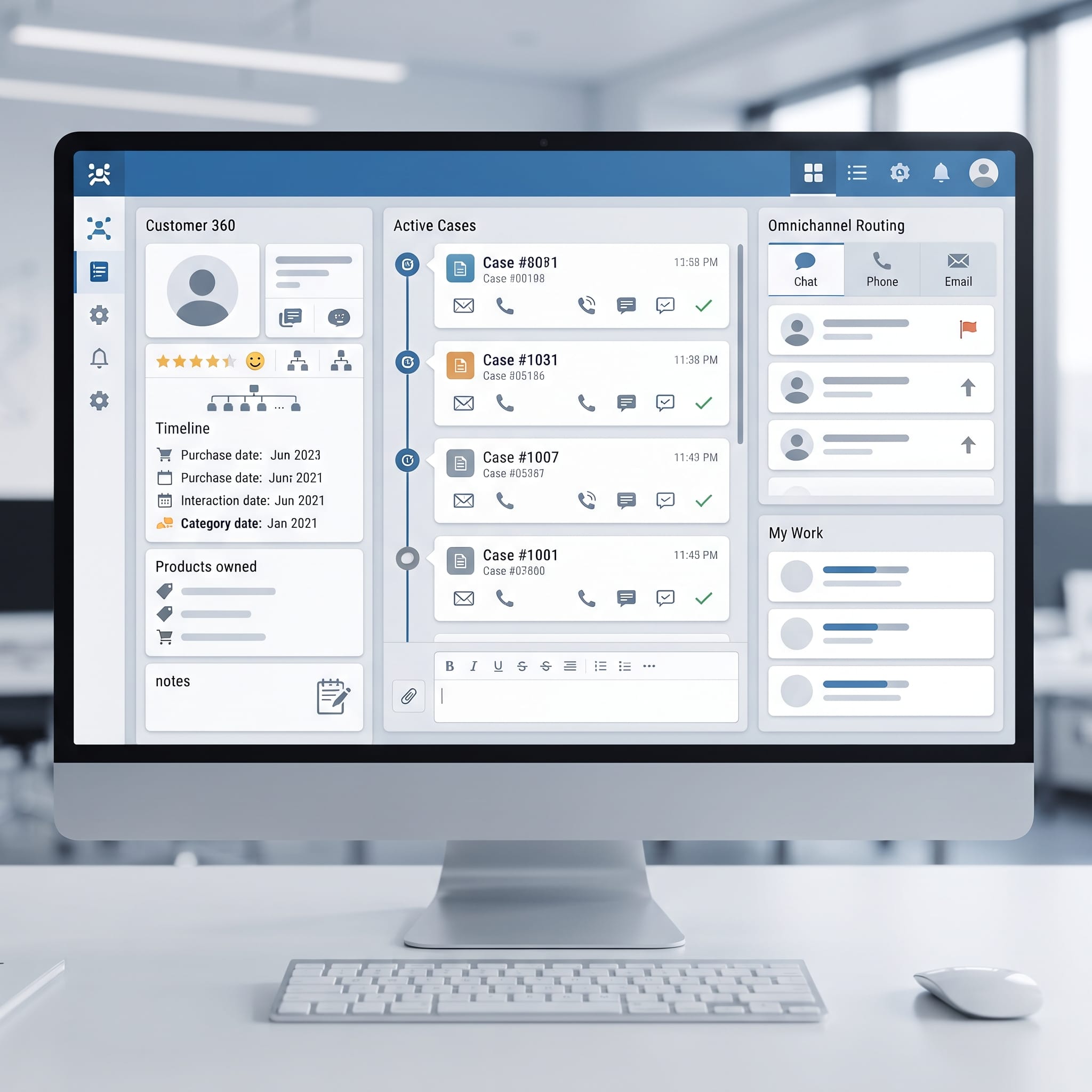
The features below work best together. Agents see the full customer story, get help finding the right answer, and can bring in a colleague without leaving the case.
Tools That Help Agents Resolve Issues Faster
Case management, knowledge, and collaboration working from one workspace.
Unified Agent Workspace
The Service Console gives agents a 360 degree view of the customer: purchases, subscriptions, warranty claims, and past conversations across email, phone, chat, and social.
Omnichannel Routing
Cases, chats, and messages are routed by skills, availability, and workload. VIP issues reach senior specialists fast, while routine questions are automated or deflected.
Service Rep Assistant and Replies
Agents get turn by turn guidance and AI drafted replies grounded in customer context and company knowledge, across live messaging, voice, and case records.
AI Powered Knowledge
Relevant articles appear inside the case as the agent works. Self Learning Knowledge spots gaps in your content and helps draft new or updated articles.
Self Service Portals
Branded, mobile responsive help centers let customers find answers on their own. Fewer routine cases reach agents, so they can focus on complex issues.
Command Center and Slack Swarming
Leaders monitor rep and AI agent conversations in real time. Agents can pull experts into a case through Slack without losing customer context.
Also Built In: Incident Management
Service Cloud also supports customer service incident management. Teams can detect widespread issues, respond in an organized way, and broadcast updates to affected customers, instead of answering the same question case by case.
3. A Six Step Framework for Integrating Service Cloud with Legacy Workflows
Implementing an enterprise CRM takes careful planning, change management, and technical alignment. Moving off legacy systems without a structure can lead to data loss and low adoption. This is the framework our consultants follow.
From Audit to Post Launch Optimization
Six steps that keep data clean, integrations stable, and people on board.
Discovery and Blueprinting
We map every customer touchpoint, catalog legacy databases and channels, and set measurable KPIs such as First Response Time, FCR, and CSAT targets.
Data Cleansing and Architecture
Dirty data only recreates old problems in a new system. We merge duplicates, archive outdated tickets, and design a data model that fits your security and compliance needs.
Core Configuration
We configure the Lightning Service Console, page layouts by role, queues, and assignment rules. Email, web to case, telephony, and chat channels are set up together.
API Integration
Service Cloud connects to your ERP, billing, and inventory systems through middleware and secure APIs. When a customer updates an address in the ERP, agents see it instantly.
User Acceptance Testing
Power users and frontline agents stress test routing rules, templates, and workflows before rollout. Their feedback shapes the final interface.
Change Management and Optimization
We provide role based training, a hypercare window after go live, and ongoing dashboard reviews to keep refining automation and agent performance.
Planning a Service Cloud rollout in India, Singapore, the Philippines, Indonesia, or Malaysia?
Talk to a Service Cloud Expert →4. Service Cloud Implementation Across Five Markets
Valuehub has a presence in Singapore, India, the Philippines, Indonesia, and Malaysia, so your project is delivered close to your teams and customers. The starting point often looks different in each market.
High Volume, Many Languages
Large customer bases and multilingual queues make omnichannel routing and self service deflection a common first priority.
Regional Hub Visibility
Regional headquarters often need one view of service performance across several markets, with consistent reporting and governance.
Scaled Support Operations
Busy support centers benefit most from real time supervisor dashboards, clean queue design, and agent guidance that shortens training time.
Messaging First Customers
Customers in a widely spread country often prefer messaging apps, so unified channels and shared case history matter most.
Multilingual Service
Language aware routing and knowledge articles help teams serve customers in several languages without splitting into separate tools.
Whatever the market, the approach stays the same. We start with your current workflows, design the data model first, and only then layer on automation and AI. That order keeps the platform reliable as ticket volumes grow across regions.
Proof from Real Salesforce Projects
Valuehub has connected sales, service, and operations data for clients across industries. Here are three examples from our Salesforce case studies.

One Connected Platform for Sales, Operations and Service
Brought the sales lifecycle, equipment maintenance tracking, and service operations of a Manila trading company onto one Salesforce platform.
Read Case Study →
Real Time Fleet Visibility on Sales and Service Cloud
Connected live GPS telemetry and odometer data to Salesforce, giving an India based fleet provider one real time view of every truck.
Read Case Study →
Customer Experience Transformation in Healthcare
Unified patient engagement and service workflows for a leading healthcare provider, lifting patient satisfaction by 40%.
Read Case Study →Accelerate Your Digital Transformation with Valuehub
Running a complex CRM migration takes technical depth, industry knowledge, and strong project management. Whether you are modernizing operations at headquarters or scaling regional hubs, a trusted partner makes the difference.
Valuehub provides end to end Service Cloud implementation, customization, and optimization, including a Service Cloud QuickStart Package for teams that want to start faster. Our team holds more than 650 Salesforce certifications across over 180 cross cloud experts, and supports clients in India, Singapore, the Philippines, Indonesia, and Malaysia.
Beyond the initial build, we also offer AI agents development, managed services, and ongoing maintenance and support. That means the same team that designs your Service Cloud setup can keep improving it after go live, as your channels, products, and customer expectations change.
Frequently Asked Questions
Who implements Salesforce Service Cloud in India, Singapore, the Philippines, Indonesia, and Malaysia?
Valuehub is a Salesforce implementation partner with a presence in all five markets. We deliver Service Cloud implementation, customization, integration, and ongoing optimization for enterprise support teams.
What is the difference between Service Cloud and Sales Cloud?
Service Cloud is built for customer support, helping teams manage and resolve customer requests. Sales Cloud is built for sales teams managing leads, opportunities, and customer relationships. Many companies run both on the same Salesforce platform. You can read Salesforce's own summary on the Service Cloud product page.
Can Service Cloud connect to our ERP and legacy systems?
Yes. Service Cloud connects to ERPs, billing platforms, and inventory systems through middleware and secure APIs, so changes in one system show up instantly in the agent console.
How long does a Service Cloud implementation take?
It depends on how many channels, data sources, and integrations are in scope. Teams that want a faster start can begin with a QuickStart Package and expand in phases, rather than launching everything at once.
Ready to remove silos, lift agent productivity, and deliver better customer experiences?
Contact Our Team Today →