

The Salesforce Winter '27 release marks a pivotal shift for enterprise organizations moving from generative AI experimentation to autonomous, measurable impact. By empowering intelligent agents to understand business context, operate across integrated systems, and execute complex workflows, this release sets a new standard for operational efficiency, and the evolution of Agentforce is at the center of it.
This guide breaks down the critical Agentforce updates in Winter '27, the architectural differences from previous versions, the rollout timeline, and what developers, admins, and end-users need to do to prepare, plus how Valuehub helps enterprises integrate these capabilities smoothly.
Key Updates for Agentforce in the Winter '27 Release
The Agentforce suite has received widespread enhancements this release, spanning agent building, channel integration, and model support.
Platform and Configuration
The Agentforce platform is now enabled by default for all orgs with Agentforce access, eliminating manual enablement steps. The Data 360 requirement to use Setup with Agentforce has also been removed.
Enhanced Builder Capabilities
Compare and merge agent versions directly in Canvas and Script views, copying improvements from a draft to a current version. Customize agent behavior per channel with explicit connection instructions.
Advanced Context & Interaction
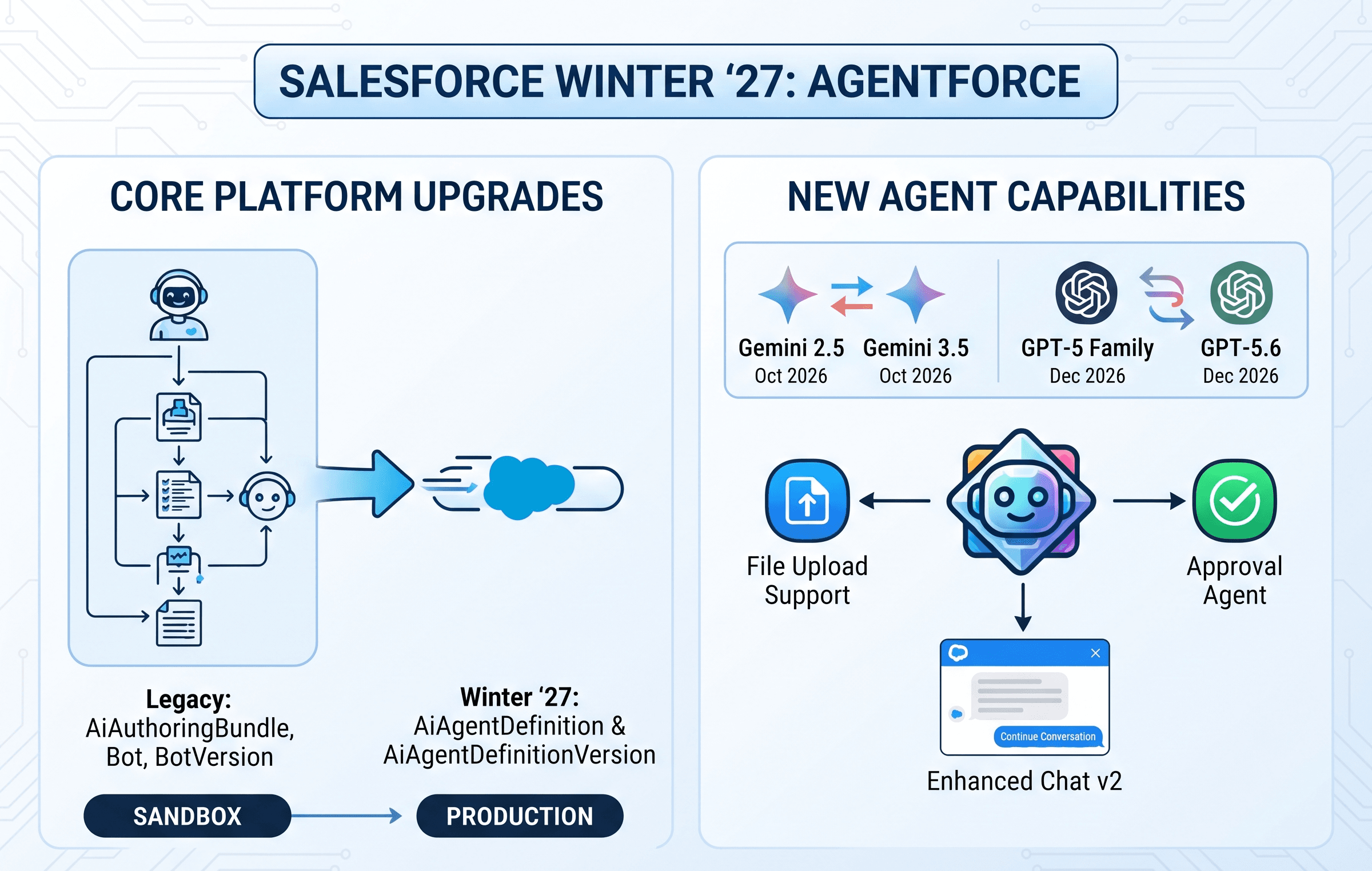
Service and Employee agents now support file uploads, images or PDFs the agent can interpret, use for context, or attach to a record, plus dynamic messaging components like custom forms and time selectors.
Expanded Model Support
Gemini 3.7 Flash and Gemini 3.6 Flash are now generally available for production use, supporting a rate limit of 1,000 requests per minute.
Standard Agent Additions
The new Approval Agent helps sales reps and reviewers manage approval workflows, submitting, recalling, and summarizing approvals to speed up decision-making.
Architectural and Functional Differences from Previous Versions
Winter '27 marks a distinct maturation from earlier Salesforce AI iterations, replacing fragmented workflows with unified, agentic orchestration.
Streamlined Metadata for Deployment
Moving an agent from sandbox to production previously required managing three separate metadata types (AiAuthoringBundle, Bot, and BotVersion) plus manual dependencies. Starting with API version 68.0, this is simplified into AiAgentDefinition and AiAgentDefinitionVersion, with Salesforce CLI automatically retrieving the agent and all its dependencies.
Improved Conversation Continuity
With Enhanced Chat v2, customers can now resume an ended or timed-out messaging session using the new "Continue Conversation" feature, and the chat interface keeps messages in view while responses load instead of scrolling out of sight.
Upgraded Voice and Telephony Capabilities
Post-call voice transcripts now display the full conversation history, including the initial agent-customer exchange, when a voice-enabled agent transfers to a human rep. Agentforce Voice also now supports dynamic routing for local phone numbers in Japan and lets developers pass custom SIP X-headers to deliver contextual information, like customer intent, from the IVR into Salesforce flows.
Field Generation Refinement
Follow-up and refinement responses in the field generation panel now strictly respect the specific model assigned to the prompt template, rather than defaulting to the org's default LLM. Administrators can also enforce a validation setting that keeps the agent focused strictly on business-related field generation, preventing Einstein credits from being spent on unrelated queries.
Availability Timeline: How and When Features Roll Out
Features become available on a rolling basis, with distinct dates for the AI model migrations specifically.
September 2026, Core Rollout
Most Agentforce updates, default platform enablement, file upload support, Builder version merging, and dynamic messaging components, begin rolling out in the first weeks of September 2026. The simplified agent metadata types are available starting in preview sandboxes the week of August 24, 2026.
October 2026, Gemini Model Rerouting
Requests on Gemini 2.5 Pro, Flash, and Flash-Lite are officially rerouted starting October 20, 2026: Gemini 2.5 Pro and 2.5 Flash route to Gemini 3.5 Flash, and Flash-Lite routes to Gemini 3.5 Flash-Lite.
December 2026, GPT-5 Family Rerouting
Organizations on the GPT-5 family (GPT-5, GPT-5-Mini, GPT-5-Nano, GPT-5-Pro) and O3 / O3-Pro must prepare for rerouting on December 11, 2026, as these are replaced by the GPT-5.6 tier (Sol, Terra, and Luna).
Preparation Strategy: Guidelines for Developers, Administrators, and Users
To fully capitalize on Winter '27, teams across the enterprise need to take proactive steps to configure, test, and adapt to the new capabilities.
For Administrators
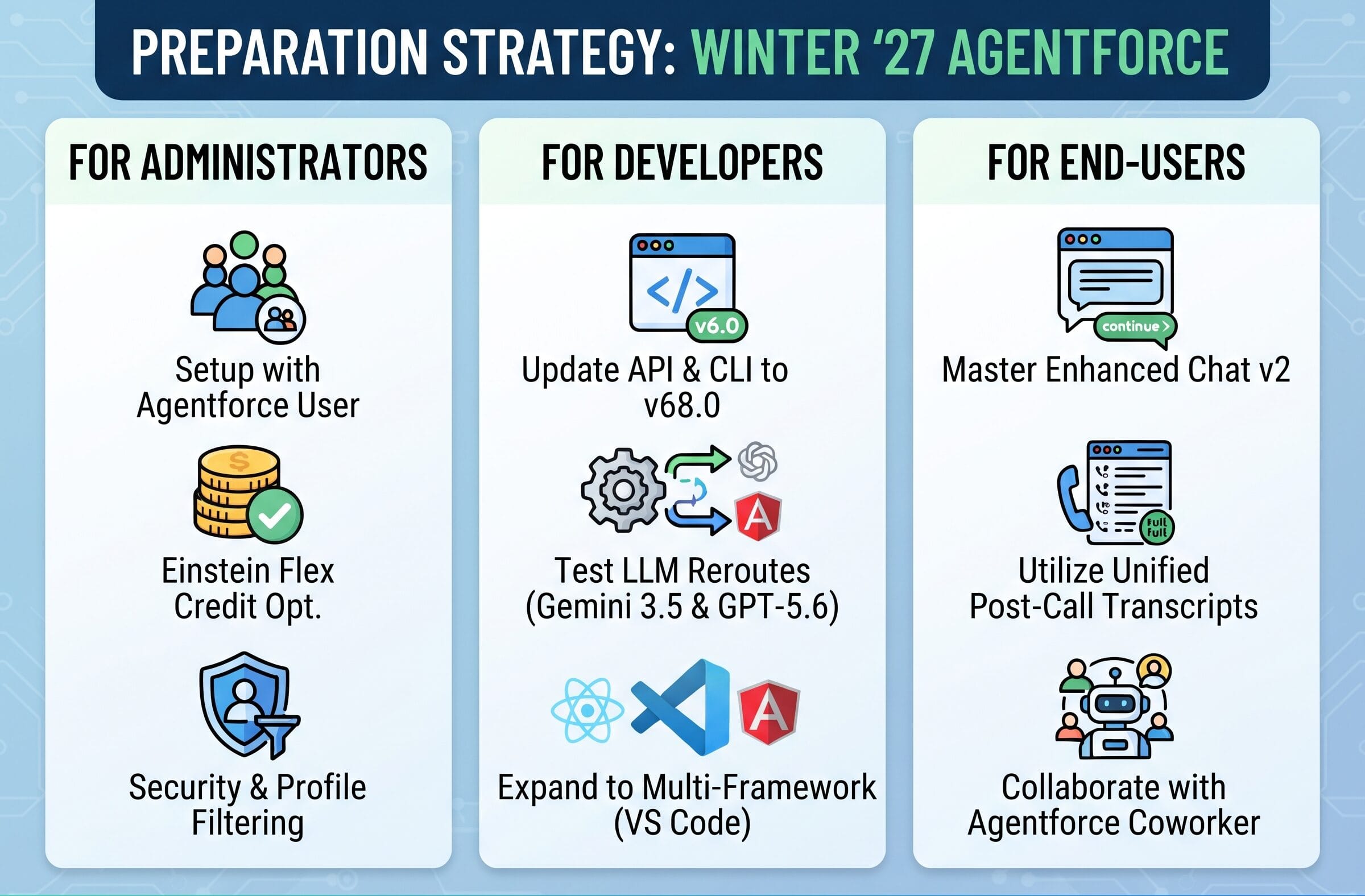
- Permission Management, use the newly consolidated Setup with Agentforce User permission set group, which bypasses the previous need to assign multiple separate permission sets.
- AI Governance and Credit Optimization, evaluate the new "Validate Field Generation Refinements" setting in Einstein Setup to keep generative AI queries focused on business use cases and optimize Flex Credit spend.
- Security Reviews, prepare for the enforcement of Profile Filtering, which prevents users from viewing profile names other than their own without explicit permission.
For Developers
- API and CLI Updates, ensure sandbox and production orgs run API version 68.0, and update the Salesforce CLI and package manifests to reference
AiAgentDefinitionandAiAgentDefinitionVersion, which are exclusively supported in second-generation managed packaging (2GP). - Model Testing, test existing prompts and applications in Prompt Builder and AI Models now, ahead of the Gemini 3.5 and GPT-5.6 reroutes, to confirm responses still meet business expectations.
- Multi-Framework Adoption, explore the Agentforce Vibes Extension for VS Code, which now supports Angular alongside React for packaging and distributing multi-framework applications via 2GP.
For End-Users
End-users get a more intuitive and responsive system. Training should cover the "Continue Conversation" feature in Enhanced Chat v2, how to read the new unified post-call transcripts, and how the new Agentforce Coworker can create or update Salesforce CRM records on request, a workflow that needs basic familiarization.
Unlocking Winter '27 Potential with Valuehub
As the Salesforce ecosystem evolves with increasingly complex autonomous agents and multi-framework architectures, partnering with a certified expert ensures your enterprise maximizes its technology investment. Valuehub operates as a CRM partner equipped to navigate the intricacies of the Winter '27 release.
Recognized as the ASEAN Enterprise SMB Partner of the Year (2025) and an official Agentforce FDE Partner Network member, Valuehub brings deep expertise in AI agent development, with over 180 cross-cloud experts and more than 650 Salesforce certifications globally.

Whether your organization needs migration to API version 68.0 for simplified agent deployments, custom development of dynamic messaging components, or strategic consulting to optimize Einstein Flex Credits against the new LLM routing, Valuehub provides end-to-end professional and managed services, backed by a 99% on-time delivery rate and 24x7 global support.
Frequently Asked Questions
Do I need to do anything for the Agentforce platform to be enabled?
No, in Winter '27, the Agentforce platform is enabled by default for all orgs with Agentforce access, so there's no manual enablement step required.
Will my existing agents break when Gemini or GPT-5 models are rerouted?
Not automatically, but responses may change. Salesforce reroutes Gemini 2.5 models on October 20, 2026 and the GPT-5/O3 family on December 11, 2026, test your prompts in Prompt Builder and AI Models against the new models before those dates.
What API version do we need for the simplified agent metadata types?
API version 68.0. AiAgentDefinition and AiAgentDefinitionVersion replace the older three-part metadata structure and are supported only in second-generation managed packaging (2GP).
Who implements Agentforce upgrades like this for enterprise orgs?
Valuehub is a Salesforce implementation partner and official Agentforce FDE Partner Network member, delivering Agentforce projects, including AI-driven sales coaching, for enterprise clients across the ASEAN region.
Ready to put Winter '27's Agentforce updates to work in your org?
Talk to Valuehub →