
A deal closes in your CRM. Then it disappears into a maze of separate pricing spreadsheets, a contract that gets redlined over email, an order system that doesn't know what was actually quoted, and a billing process that reconciles everything by hand weeks later. Salesforce calls this the "messy middle," and it's exactly what Revenue Cloud was built to eliminate. Here's what the platform actually does, why it recently changed its name, and how Valuehub implements it end to end.
What Is Salesforce Revenue Cloud? (And Why Is It Now Called Agentforce Revenue Management?)
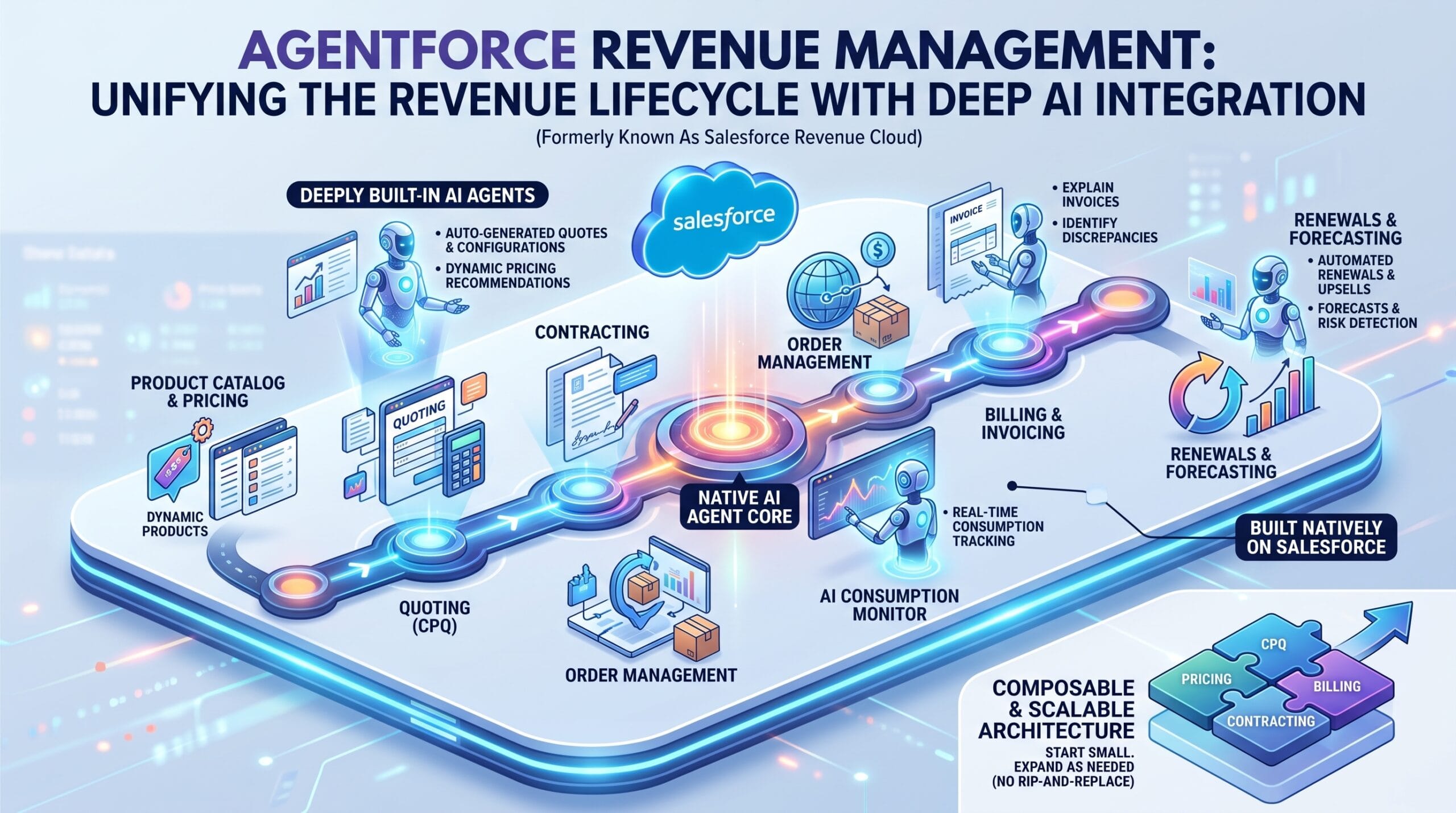
Salesforce Revenue Cloud is a complete revenue lifecycle management platform built natively on Salesforce, unifying product catalog and pricing, quoting, contracting, order fulfillment, and invoicing into one system. In 2025, Salesforce renamed it Agentforce Revenue Management to reflect a deeper shift: AI agents are now built into the platform to generate quotes, manage renewals, monitor consumption, and explain invoices, rather than sitting alongside it as an add-on. The core capabilities haven't changed, the name just better reflects where the product is headed. Because it's composable, you can start with just the piece you need most (pricing, CPQ, billing) and expand over time, rather than a rip-and-replace project.
A Quick History (Why You'll See Three Different Names for the Same Thing)
If you've researched this platform before, the naming has genuinely shifted more than once, and it's worth knowing why. It began as Configure, Price, Quote (CPQ), a managed package now confirmed for end of sale, though existing customers still get support. As subscription and usage-based business models grew, Salesforce needed something broader: Revenue Lifecycle Management launched in Spring '24, was renamed Revenue Cloud Advanced at Dreamforce '24, and, with Agentforce layered in throughout 2025, is now marketed as Agentforce Revenue Management. Unlike the legacy CPQ managed package, the current platform is built fully on the core Salesforce platform, which is a meaningful architectural difference: no separate managed-package limitations, and native integration with Sales Cloud and Service Cloud out of the box.
Core Capabilities We Implement
- Product Catalog & Price Management, define products, bundles, and configuration rules once, with support for fixed, tiered, volume, matrix, and usage-based pricing across every channel.
- Configure, Price, Quote (CPQ), a constraint-based configurator for complex, multi-year deals, with real-time pricing calculations and full price-waterfall visibility.
- Contract Lifecycle Management, AI-assisted clause generation, collaborative redlining, and automated amendments, instead of a contract process that lives outside the CRM.
- Order Fulfillment & Orchestration, a Dynamic Revenue Orchestration engine that decomposes orders, tracks fulfillment dependencies, and flags bottlenecks before they become customer complaints.
- Billing & Invoice Management, automated billing for subscriptions, usage, and one-time purchases, with consumption pricing, self-service payment portals, and data that flows directly into your ERP for revenue recognition.
- Revenue Analytics, Tableau Next-powered dashboards for ARR, MRR, churn, pricing effectiveness, and order fulfillment, so finance isn't waiting on a monthly export to understand the business.
How Valuehub Approaches a Revenue Cloud Rollout
We start by mapping your actual pricing complexity and existing quote-to-cash process, where deals get stuck today, and whether that's a CPQ problem, a billing problem, or both. From there we build the product catalog and pricing model first, layer in CPQ and contract workflows, and only connect billing to your downstream ERP or accounting system once the upstream data is clean. This sequencing matters: automating a billing process built on inconsistent pricing data just moves the errors downstream faster.
For businesses on QuickBooks or Xero rather than a full ERP, we also offer Vebo and Vero, our own two-way Salesforce integrations that keep invoices, payments, and accounts synced in real time, so Revenue Cloud's billing data actually lands somewhere useful. And for revenue processes built around partner or affiliate commissions specifically, our Performance Marketing accelerator adds a dedicated reconciliation engine for commission payouts on top of the same Salesforce foundation.
Proven Track Record in Pricing Accuracy & Revenue Operations
Valuehub has delivered the pricing accuracy and sales agreement management capabilities that sit at the center of Revenue Cloud, across retail commerce and manufacturing clients.

30% Revenue Growth with B2B Commerce & SAP Integration
Read Case Study →
Unifying B2B and B2C Sales Operations for a Cable Manufacturer
Read Case Study →For the outdoor lifestyle brand, we rebuilt a complex, multi-channel product catalog and pricing model on Salesforce B2B Commerce with SAP integration, cutting pricing and order errors by 50% and tripling B2B online orders, the exact category of problem Revenue Cloud's catalog and pricing engine is built to solve. You can see this and our other Salesforce case studies on our site.
Frequently Asked Questions
Who implements Salesforce Revenue Cloud?
Valuehub is a Salesforce implementation partner delivering CRM and revenue-operations projects for clients across Singapore, India, Malaysia, Indonesia, and the Philippines, following the same assess-build-automate approach we use across our other Salesforce industry-cloud work.
What's the difference between Salesforce CPQ and Revenue Cloud?
Salesforce CPQ was a managed package focused specifically on the deal-structuring phase, configuring products, applying pricing, and generating quotes, and is now confirmed for end of sale. Revenue Cloud includes that same CPQ functionality but expands it to cover contract lifecycle management, order orchestration, asset lifecycle management, billing and invoicing, and revenue analytics, all built on the core Salesforce platform rather than a managed package.
Does Revenue Cloud connect to our existing ERP or accounting system?
Yes. Billing data is designed to flow directly into your ERP for revenue recognition, and the platform is API-first for broader integration. For businesses running QuickBooks or Xero specifically rather than a full ERP, Valuehub's own Vebo and Vero integrations keep that data synced in real time.
Can Revenue Cloud support subscription and usage-based billing?
Yes, it was purpose-built for subscription, consumption, and hybrid revenue models rather than retrofitted from older transactional software, with token grants, commitments, and rating engines for usage-based pricing specifically.
How long does a Revenue Cloud implementation take?
It depends on how many pricing models, channels, and downstream systems (ERP, accounting, payment processors) are in scope. Because the platform is composable, most engagements start with the highest-friction piece, usually pricing accuracy or quoting, rather than a single big-bang rollout of every capability at once.
Deals closing in your CRM but revenue still stuck in the messy middle?
Talk to Valuehub →